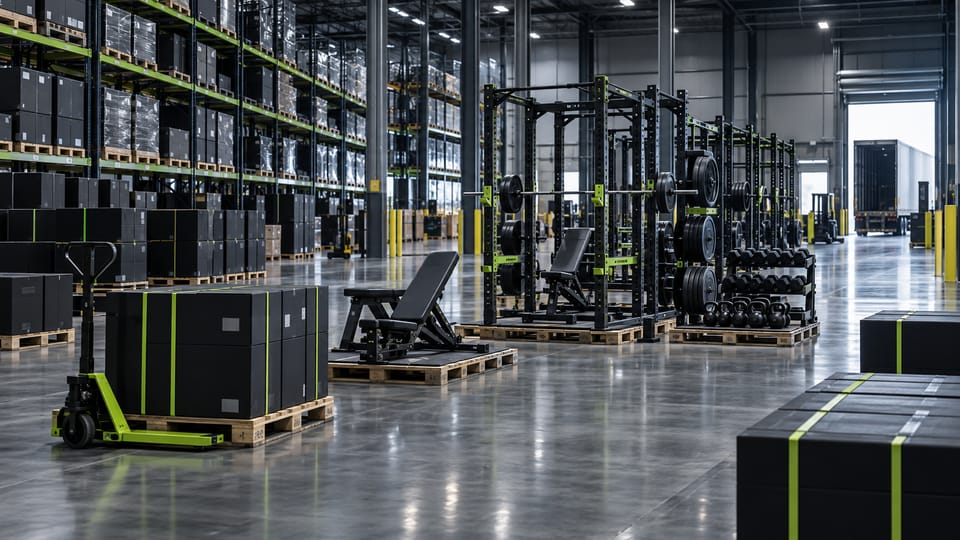
A branded launch often needs weights from one partner factory, a bench from another, and labeled accessories from a third. Consolidation is the plan that brings the goods together before the container is booked. This note is how a brand owner should write that plan with OKTOP.
OKTOP FITNESS is a trading company in Nantong. We coordinate partner factories. We do not build the equipment. Freight terms, the port and the document set are the ones written on the quotation, not the ones assumed from this page.
Decide what "together" means before anyone books space
"Ship together" is not precise enough. Say which of the following you actually need:
- Every code on the first order must be on the same vessel, in the same container.
- A dealer-facing core must arrive together, and slower development items may follow.
- Codes can arrive in more than one container, but they must clear the same customs entry.
- A warehouse can receive two arrivals, as long as the packing lists use the same carton marks and the same product codes.
Write that decision against the code list, not in a later chat. The matching note shows which partner makes each line. If a line is still unsigned, it does not belong in the "must arrive together" group.
What the consolidation brief should include
Send the plan with the order release, or earlier if the list already looks stable. Include:
- The codes that must travel together, and the codes that may ship later.
- The carton marks you want on every outer carton, so receiving does not have to learn three systems.
- Whether mixed codes may share a pallet, or whether each code must stay in its own pallet range.
- How many units sit in an export carton for each code, once that figure is known.
- The document set the importer has already named: commercial invoice, packing list, and any other paper you have already confirmed exists for those codes.
- The forwarder, the port, and who books the freight, if those are already agreed on the quotation.
If a retailer needs a label in a fixed position, that belongs in the dieline approval, not in a message after the cartons are printed.
Packing lists have to be usable at the warehouse
A consolidation fails in the warehouse as often as it fails at the port. Ask for a packing list before the container is closed, while a wrong count can still be corrected. The list should tie each carton range to a code and to the sample identification that code must follow. It should keep accessories, spare-parts bags and manuals on their own lines when they are packed separately. A single line that says "fitness equipment" is not a packing list.
If goods from more than one partner are closed into one container, the receiver must still be able to count by code. The sample-to-shipment note covers inspection against the signed sample. Consolidation adds the requirement that the counts from each partner still add up on one list.
Timing: do not force an unsigned line into a booked container
Each partner factory will have its own date when goods are ready. Consolidation only works if those dates can be held long enough for the last agreed line to join the others, or if the brand accepts a split. This site does not print those dates. Ask us for a quote, and ask the quote to show readiness by partner, not as one blended date.
If one line is late because a sample was rejected, take it out of the consolidated group in writing. A late ODM bench should not hold a finished OEM weight shipment unless you explicitly want it to.
Inspection should be planned against the same group. If you want a check on your behalf, say whether it happens at each partner before the goods move, at the consolidation point, or both. The review is a count, a visual match to the sample, a check of the mark, and a check of the carton text. It is not a certificate.
Documents and terms stay on the quotation
OKTOP can remain the single point of contact for packing documents and freight. That does not mean every term is included. Do not assume insurance, destination cartage, or an inland delivery unless the quotation says so.
Name the document set early. If a paper is required and it is not available for a code, either that code waits, or the shipment moves without it and the file records that decision. This site does not publish certificates and does not transfer a document from one code to another.
When several partners contribute, ask for one commercial invoice structure the importer can read, with the codes still visible. The brand name, the catalog code and the quantity should be the same on the invoice, the packing list and the carton mark.
What the brand team should keep
After the goods leave, file the consolidation plan, any later split you accepted, the matched partner list, the packing list that traveled, the document set that traveled, and the inspection notes by code.
The first assortment decides which codes belong on the first shipment at all. Matching names the partners. This note decides how those partners' goods become one arrival. Use the enquiry form when you know which codes must arrive together. Company facts are on the about page.
Questions brand owners ask about consolidation
Can goods from more than one partner factory travel in the same shipment?
Yes. Tell us which codes must arrive together and which may follow. Freight terms stay on the quotation.
When should the packing list be reviewed?
Before the container is closed, so a wrong count can still be corrected. The list should tie carton ranges to codes and to the approved sample.
Does consolidation change the inspection?
It can change where the check happens, but not what it is compared with. The signed sample and the release remain the reference. The review is not a certificate.